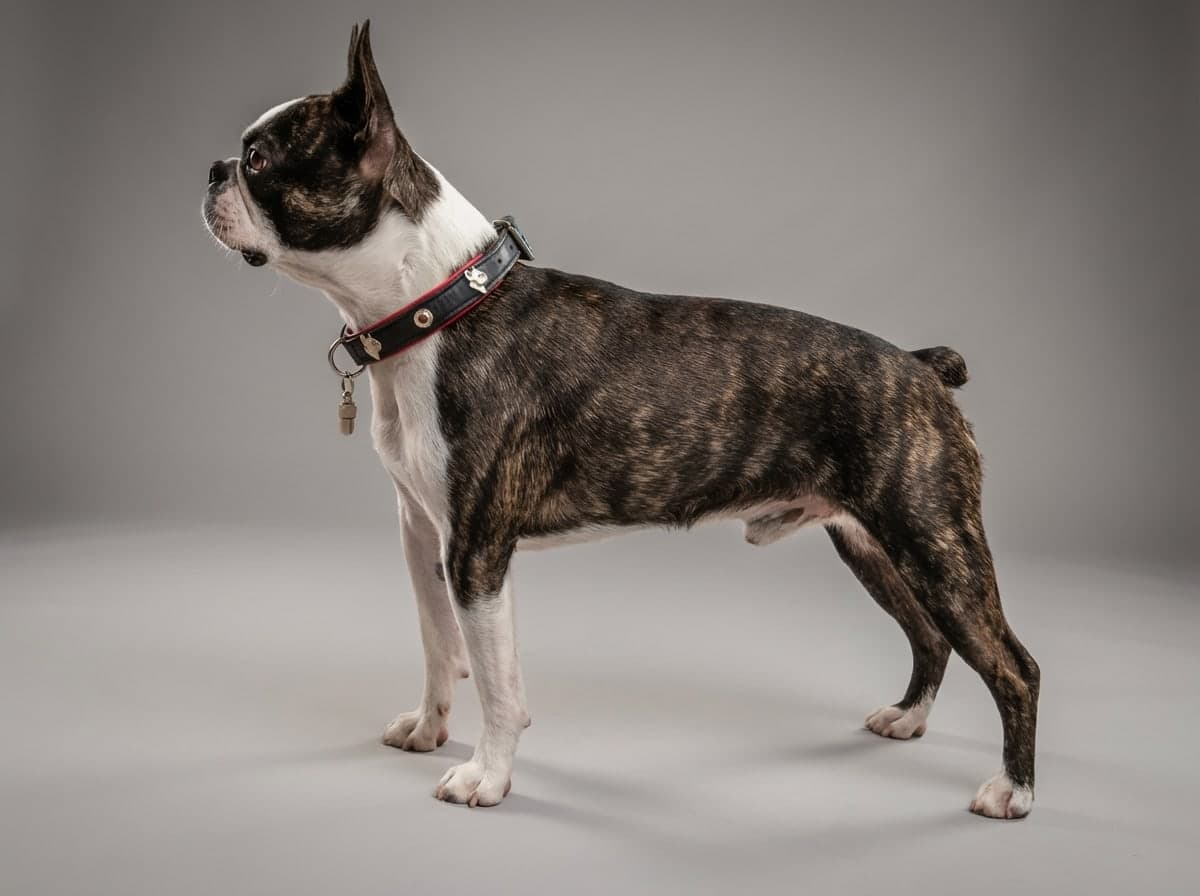
small · Non-Sporting
Compare their size, temperament, care needs, health evidence and household fit using published structured data.
This comparison uses the published records for Boston Terrier and Maltshi to explain the differences that are most useful when choosing a dog. Boston Terrier is classified as a small breed with an energy score of 3/5, while Maltshi is classified as small with an energy score of 3/5. The page also compares adult measurements, trainability, grooming, shedding, household suitability, climate information, growth modeling and approved health evidence. Their recorded energy scores are equal. These are breed-level tendencies rather than promises about an individual dog. Use the comparison to create a shortlist, then consider the dog’s temperament, health, background and your realistic capacity for exercise, training, grooming and veterinary care.
Quick verdict: Both breeds have the same trainability score of 4/5. Boston Terrier has the lower grooming requirement. Their apartment-suitability scores are equal. Boston Terrier has the higher child-suitability score. No breed is universally better; the stronger match depends on the owner’s priorities and the individual dog.
Scores summarize breed-level tendencies on the documented 1–5 methodology. They do not predict an individual dog’s behavior or health.
| Characteristic | Boston Terrier | Maltshi |
|---|---|---|
| Size category | small | small |
| Male weight | 5-11 kg | 2.7-6.8 kg |
| Female weight | 5-11 kg | 2.7-6.8 kg |
| Male height | 38-43 cm | 20-28 cm |
| Female height | 38-43 cm | 20-28 cm |
| Lifespan | 11–13 years | 10–16 years |
| Breed group | Non-Sporting | Mixed |
| Energy | 3/5 | 3/5 |
| Trainability | 4/5 | 4/5 |
| Grooming | 1/5 | 4/5 |
| Shedding | 2/5 | 1/5 |
| Child suitability | 5/5 | 3/5 |
| Dog compatibility | 4/5 | 4/5 |
| Apartment suitability | 5/5 | 5/5 |
| Origin | Boston, Massachusetts, United States | United States |
| Coat types | Short, Smooth | Silky |
| Coat colors | Not available | Not available |
| Temperament | Boston Terrier | Maltshi |
|---|---|---|
| Imported traits | Friendly, intelligent, outgoing, playful | Affectionate, playful, friendly, gentle, outgoing, intelligent |
Boston Terrier is classified as small, while Maltshi is small. Adult ranges are separated by sex below because combining them can hide useful differences. Coat facts use imported structured values; body structure and coat length remain unavailable until supported sources are added.
| Characteristic | Boston Terrier | Maltshi |
|---|---|---|
| Male weight | 5-11 kg | 2.7-6.8 kg |
| Female weight | 5-11 kg | 2.7-6.8 kg |
| Male height | 38-43 cm | 20-28 cm |
| Female height | 38-43 cm | 20-28 cm |
| Body structure | Source data required | Source data required |
| Coat type | Short, Smooth | Silky |
| Coat length | Source data required | Source data required |
| Coat colors | Not available | Not available |
The imported trait lists describe broad tendencies. Boston Terrier records emphasize Friendly, intelligent, outgoing; Maltshi records emphasize Affectionate, playful, friendly. Socialization, training, health and the individual dog strongly affect behavior.
| Characteristic | Boston Terrier | Maltshi |
|---|---|---|
| Imported temperament | Friendly, intelligent, outgoing, playful | Affectionate, playful, friendly, gentle, outgoing, intelligent |
| Friendly / affectionate | Not separately scored | Not separately scored |
| Alert / protective | Not separately supported | Not separately supported |
| Independent / courageous | Not separately supported | Not separately supported |
| Stranger friendliness | Source data required | Source data required |
| Sensitivity | Source data required | Source data required |
Boston Terrier scores 5/5 for child suitability and 4/5 for dog compatibility; Maltshi scores 3/5 and 4/5. These scores support initial research, but supervision, introductions and individual assessment remain essential.
| Characteristic | Boston Terrier | Maltshi |
|---|---|---|
| Families | 5/5 child score | 3/5 child score |
| Young children | 5/5; supervision required | 3/5; supervision required |
| Older children | 5/5 | 3/5 |
| Seniors | No dedicated score | No dedicated score |
| First-time owners | 4/5 trainability | 4/5 trainability |
| Multi-dog homes | 4/5 | 4/5 |
| Homes with cats | Source data required | Source data required |
| Single-person households | Assess exercise and alone-time needs | Assess exercise and alone-time needs |
Trainability is not the same as intelligence or obedience. The available 4/5 and 4/5 scores indicate general responsiveness, while stubbornness, attention span and a preferred training style require more specific evidence. Reward-based, consistent training and early socialization are appropriate starting principles.
| Characteristic | Boston Terrier | Maltshi |
|---|---|---|
| Trainability | 4/5 | 4/5 |
| Intelligence | Not separately measured | Not separately measured |
| Obedience | Not separately measured | Not separately measured |
| Stubbornness | Source data required | Source data required |
| Attention span | Source data required | Source data required |
| Early training | Start early and remain consistent | Start early and remain consistent |
| Socialization | Early, controlled positive exposure | Early, controlled positive exposure |
| Training style | Reward-based; adapt to individual | Reward-based; adapt to individual |
The structured energy scores are 3/5 for Boston Terrier and 3/5 for Maltshi. The higher score suggests greater general activity demand, but exact walking minutes, running distance and puppy exercise limits should not be inferred from a score alone.
| Characteristic | Boston Terrier | Maltshi |
|---|---|---|
| Energy score | 3/5 | 3/5 |
| Daily exercise | Moderate general demand | Moderate general demand |
| Walking time | Individual plan required | Individual plan required |
| Play and mental stimulation | Regular requirement | Regular requirement |
| Running / hiking | Veterinary and maturity assessment | Veterinary and maturity assessment |
| Puppies | Short age-appropriate sessions | Short age-appropriate sessions |
| Seniors | Adapt to health and mobility | Adapt to health and mobility |
Grooming and shedding are shown separately: a breed can shed heavily without requiring professional clipping. Boston Terrier is 1/5 for grooming and 2/5 for shedding; Maltshi is 4/5 and 1/5.
| Characteristic | Boston Terrier | Maltshi |
|---|---|---|
| Grooming need | 1/5 | 4/5 |
| Shedding | 2/5 | 1/5 |
| Brushing | Routine | Frequent |
| Bathing | As coat and lifestyle require | As coat and lifestyle require |
| Seasonal shedding | Not separately documented | Not separately documented |
| Professional grooming | Breed/coat dependent | May be needed |
| Estimated cost | Requires owner location and provider data | Requires owner location and provider data |
These records identify conditions or screenings reported by configured sources. They do not mean every dog will develop a condition, and absence from this table does not establish that a breed has no risk.
Joint, eye, heart and genetic-testing guidance appears only when an approved health source explicitly supports it. Discuss breed-specific screening and symptoms with a veterinarian.
Calorie needs vary with current weight, age, neuter status, activity and body condition. This page does not invent a breed-wide calorie target. The feeding records below identify only supported breed-level considerations and should be combined with veterinary advice.
| Characteristic | Boston Terrier | Maltshi |
|---|---|---|
| Feeding profile | Choose a complete diet appropriate to life stage, monitor body condition and adjust intake for the individual dog's activity and veterinary needs. Breed name alone cannot determine a fixed portion. | Choose a complete diet appropriate to life stage, monitor body condition and adjust intake for the individual dog's activity and veterinary needs. Breed name alone cannot determine a fixed portion. |
| Obesity tendency | Not available | Not available |
| Large-breed puppy | No / not flagged | No / not flagged |
| Feeding frequency | Depends on life stage | Depends on life stage |
| Typical calories | Use individual calorie calculation | Use individual calorie calculation |
Apartment suitability is 5/5 versus 5/5. A lower apartment score does not mean a breed cannot live in one; exercise, enrichment, noise, training and building rules can be more important than floor area alone.
| Characteristic | Boston Terrier | Maltshi |
|---|---|---|
| Apartment suitability | 5/5 | 5/5 |
| House suitability | Depends on daily care capacity | Depends on daily care capacity |
| Yard requirement | A yard does not replace exercise | A yard does not replace exercise |
| Hot climate | 3/5 | 3/5 |
| Cold climate | 3/5 | 3/5 |
| Noise level | Source data required | Source data required |
| Tolerance for being alone | Source data required | Source data required |
| Space requirement | small | small |
Purchase, adoption, veterinary, insurance, training and grooming costs vary significantly by country, city, provider and the individual dog. No defensible location-based source is configured yet, so this comparison does not publish invented currency ranges.
| Characteristic | Boston Terrier | Maltshi |
|---|---|---|
| Puppy purchase | Local ethical-source data required | Local ethical-source data required |
| Adoption | Local rescue data required | Local rescue data required |
| Food | small-size baseline; calculate locally | small-size baseline; calculate locally |
| Grooming | 1/5 demand | 4/5 demand |
| Veterinary care | Individual and local | Individual and local |
| Insurance | Location and policy required | Location and policy required |
| Training | Provider and needs dependent | Provider and needs dependent |
| Equipment | small equipment | small equipment |
| Annual cost | Local calculator/source required | Local calculator/source required |
Growth pages scale the imported adult endpoints using the documented size-category model. They are educational estimates rather than observed puppy cohorts. Follow each breed’s chart for age-by-age values and an interactive adult-size estimate.
| Characteristic | Boston Terrier | Maltshi |
|---|---|---|
| Adult weight | 5–11 kg | 2.7–6.8 kg |
| Adult height | 38–43 cm | 20–28 cm |
| Growth speed | small model | small model |
| Full height | See modeled chart | See modeled chart |
| Adult weight reached | See modeled chart | See modeled chart |
| Sex differences | Separate male/female endpoints | Separate male/female endpoints |
Every point above is derived from the displayed structured scores. A low score is not automatically a flaw, and a high score is not automatically an advantage.
Choose based on the individual dog, ethical sourcing or rescue assessment, household capacity, training commitment and veterinary needs—not a single score.
Adjust eight household preferences. The result recalculates only from the comparison’s documented size, care, suitability and climate scores.
This is decision support, not a universal recommendation. Individual temperament, health, availability and responsible sourcing still matter.
Boston Terrier has an adult range of 5–11 kg; Maltshi has an adult range of 2.7–6.8 kg. Ranges may overlap.
Both breeds has the higher structured exercise score (3/5 versus 3/5).
Both breeds has the higher trainability score (4/5 versus 4/5).
Both breeds has the higher apartment-suitability score. Exercise, noise and individual behavior still matter.
Boston Terrier has the higher shedding score (2/5 versus 1/5).
Boston Terrier has the higher child-suitability score. Individual temperament and supervision remain essential.
The imported lifespan ranges are 11–13 years for Boston Terrier and 10–16 years for Maltshi; ranges can overlap and do not predict an individual dog.
A defensible answer requires the owner’s location plus current food, veterinary, insurance, grooming and training prices. This page does not invent a universal cost winner.
Cat compatibility is not separately supported in the current structured records. Introductions, prey drive, prior experience and individual behavior require assessment.
Both breeds has the higher trainability score, but exercise, grooming and individual behavior also affect first-time-owner fit.
This page compares structured values already stored for each breed. It does not generate new factual claims from the breed names. Missing values remain unavailable rather than being invented.