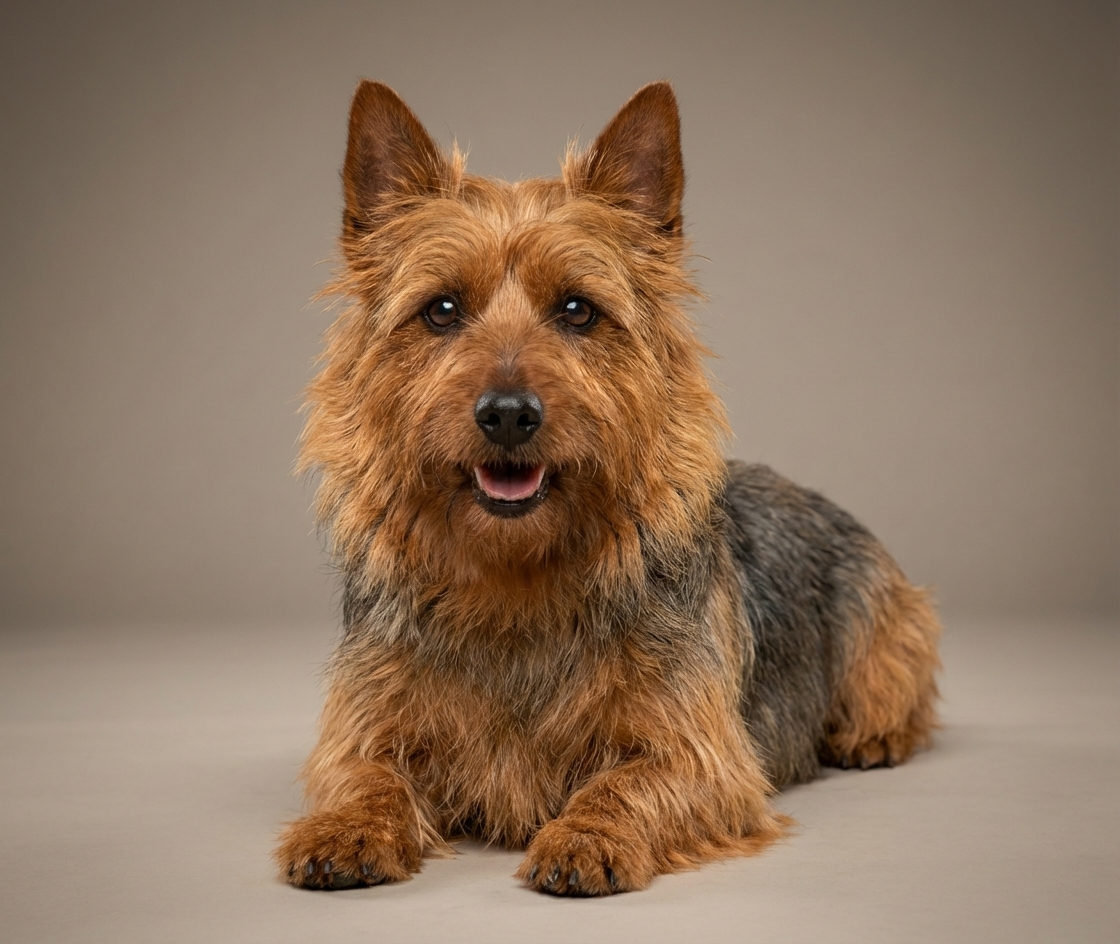
Terrier breed from Australia
The Australian Terrier is a small, sturdy terrier with a harsh double coat and a distinctive topknot. It is known for its spirited, alert expression and courageous personality. This breed is described as courageous, alert, friendly, loyal, and intelligent. It has an estimated lifespan of 11 to 15 years. Adult males and females both stand about 25 to 28 cm tall and weigh approximately 7 to 9 kg. The breed's energy and trainability are both rated 4 out of 5, suggesting a moderately high activity level and a willingness to learn. Grooming needs are moderate (score 3), while shedding is low (score 2). The Australian Terrier is generally well-suited to apartment living (score 4) and shows moderate compatibility with children (score 3) and other dogs (score 3). Individual temperaments can vary, so these scores represent general tendencies rather than guarantees.
The Australian Terrier was developed in Australia during the 19th century from British terrier breeds, including the Cairn, Skye, and Yorkshire Terriers. It was bred as an all-purpose exterminator of rodents and snakes, as well as a loyal watchdog and companion. The breed's origins are firmly in Australia, and it belongs to the Terrier group. Recognition status varies by registry; for example, the American Kennel Club recognized the breed in 1960. However, because recognition dates and details differ among registries, the exact timeline of official recognition is not uniform. The breed's history is tied to its working role as a vermin hunter, but specific historical events beyond its development in 19th-century Australia are not documented in the available facts.
Breed tendencies are general guidance. Individual behavior depends on genetics, socialization, training, health and environment.
Higher daily exercise demand
Typically responsive to training
Moderate compared with other breeds
Lower shedding tendency
Supervise every dog–child interaction.
Introductions and socialization still matter.
Exercise, enrichment and noise tolerance affect fit.
Modelled tendency · medium confidence
A general morphology-based tendency. Individual dogs still require shade, shelter, water, acclimation and weather-appropriate activity. Method: climate-morphology-v1.
No Australian Terrier-specific screening programme or peer-reviewed disorder-prevalence study is currently attached to this profile. This is not evidence that the breed has no health risks. Owners should use routine preventive veterinary care and discuss screening appropriate to the individual dog's history, examination and family line.
Veterinary disclaimer: This profile is educational and does not replace examination, diagnosis or treatment by a veterinarian.
Reviewed feeding guidance will appear after an approved source is imported and editorially reviewed.
Compare male and female growth, check weight by age and estimate mature size.
Preview only. Open the complete chart to adjust age, current weight and measurement units.
The Australian Terrier is a small breed. Adult males and females both stand about 25 to 28 cm tall and weigh approximately 7 to 9 kg. The estimated lifespan is 11 to 15 years. These figures are modelled estimates, so individual dogs may vary.
The breed is described as courageous, alert, friendly, loyal, and intelligent. However, individual dogs may not display all these traits consistently. Temperament can vary based on upbringing, socialization, and genetics.
The breed has an energy score of 4 out of 5, indicating a moderately high activity level. Regular daily exercise, such as walks and playtime, is recommended to keep them physically and mentally stimulated.
Grooming needs are moderate (score 3 out of 5). The breed has a harsh double coat that requires regular brushing to prevent matting and to manage shedding, which is low (score 2). Occasional professional grooming may be needed.
Yes, the breed scores 4 out of 5 for apartment suitability, suggesting it can adapt well to smaller living spaces provided it gets enough exercise. However, individual energy levels and behavior may vary.
The breed has moderate child suitability (score 3) and dog compatibility (score 3). This means it can be good with children and other dogs if properly socialized, but interactions should always be supervised. Individual temperament plays a significant role.
The Australian Terrier originates from Australia. It was developed in the 19th century from British terrier breeds such as the Cairn, Skye, and Yorkshire Terriers. It was bred as an all-purpose exterminator of rodents and snakes, as well as a watchdog and companion.
Image source: The Dog API. Last reviewed 7/20/2026.